Base Ten Blocks
Numbers & Operations in Base Ten
Learn to visualize and understand place value concepts using base ten blocks. These manipulatives help connect abstract number ideas with concrete representations.
Learning Objectives
- Understand the concept of base ten blocks and their values
- Represent two-digit numbers using base ten blocks
- Practice counting and manipulating numbers using visual models
What Are Base Ten Blocks?
Base ten blocks are physical or virtual tools that help us visualize our number system. They allow us to see and understand place value concepts in a hands-on way.
Fun Fact
Base ten blocks were developed by educational researchers as a way to make abstract number concepts more concrete for young learners!
Types of Base Ten Blocks
| Thousands | Hundreds | Tens | Ones |
|---|---|---|---|
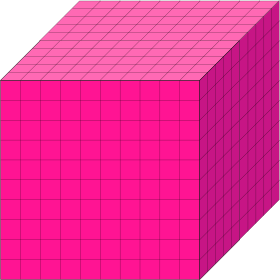 | 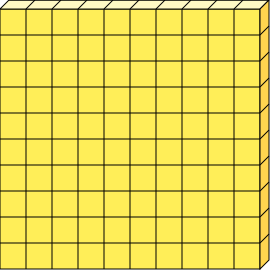 |  | 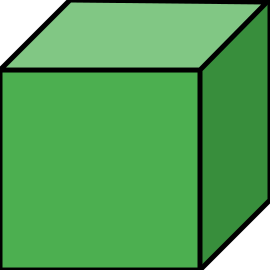 |
| Cube | Flat | Rod | Unit |
| Equal to 10 flats or 1,000 unit cubes. | Equal to 10 rods or 100 unit cubes. | Equal to 10 unit cubes connected in a row. | The basic building block representing one unit. |
Representing Numbers with Base Ten Blocks
Let's see how to represent different numbers using base ten blocks. We'll use rods for tens and unit cubes for ones.
Number: 23
| Tens: | Ones: |
|---|---|
| |
2 tens + 3 ones = 23 | |
Number: 46
| Tens: | Ones: |
|---|---|
| |
4 tens + 6 ones = 46 | |
Interactive Base Ten Blocks
Try building different numbers using base ten blocks. Click on the blocks to add them to the workspace, then see what number you've created!
Base Ten Blocks Builder
Build numbers by clicking on the blocks below
Click on the blocks to add:
Your workspace:
Tens:
Ones:
Current number:
2
4
Try These Challenges!
Challenge 1:
Build the number 35 using base ten blocks. How many tens and ones do you need?
Challenge 2:
If you have 4 tens and 7 ones, what number have you built?
Challenge 3:
What happens if you trade 10 ones for 1 ten? Does the number change?
Challenge 4:
How would you represent the number 100 using base ten blocks?
Real-World Connection
Base ten blocks help us understand our money system too! Think about:
- A penny is like a unit cube (1)
- A dime is like a rod (10)
- A dollar can be compared to a flat (100)
Key Takeaways
- Base ten blocks help us see the place value of numbers
- Unit cubes represent ones, rods represent tens, and flats represent hundreds
- Using these blocks makes it easier to understand addition, subtraction, and regrouping